Mi-Go
The Colour Out of SpaceThe Mi-Go are an extraterrestrial race described in Vermont legends and later identified in Henry Wentworth Akeley’s account as beings of alien, fungus-like biology. They first enter the narrative through flood reports and inherited stories that Albert N. Wilmarth dismisses as folklore, but their physical form, unusual means of travel, and mining presence gradually give those stories a concrete and unsettling shape.
Identity and Early Reports
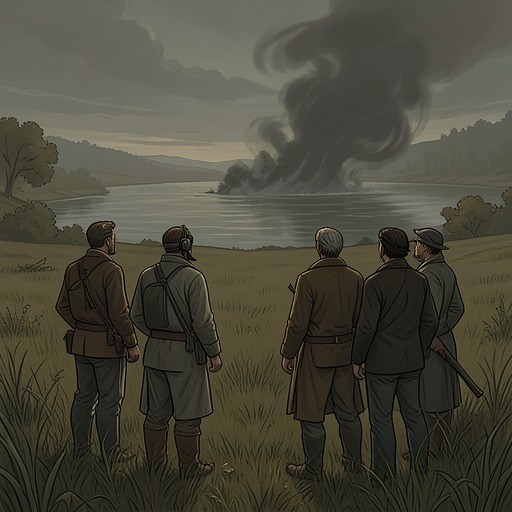
Reports associated with the 1927 Vermont flood described pinkish organic bodies roughly five feet long, neither human nor any animal known in Vermont. Witnesses recalled crustacean-like bodies, large dorsal fins or membranous wings, several sets of articulated limbs, and a convoluted, antenna-covered ellipsoid in place of a familiar head. Accounts from different sources resembled one another closely. Wilmarth initially judged that frightened observers had seen bloated human or farm-animal bodies in the floodwaters and, under the influence of local tales, imagined monstrous features.
The older legends offered a more elaborate picture. Their common names for the beings included those ones and the old ones; Pennacook tradition called them the Winged Ones. The stories placed them in remote hills, deep woods, and steep gorges, where signs of their presence supposedly included strange prints, stone circles, and caves blocked by boulders. In some accounts, the beings kept apart from people except when humans entered their territory; later tales added secret outposts, claw-prints near farmhouses, disappearances, and buzzing voices imitating human speech. These are traditions reported within the narrative, not all independently verified observations.
Form and Movement
The descriptions emphasize a body that is recognizably organic but difficult to fit into human categories. In folklore, the Mi-Go resemble huge, light-red crabs with many pairs of legs and two large, bat-like wings set along the back. They could walk on all their legs or rear up on their hindmost pair, using the others to carry large objects. One story describes a group wading three abreast through a shallow woodland stream in an apparently disciplined formation. Another tells of a creature launching from a bare hill at night and disappearing into the sky after its wings briefly showed against the full moon.
Akeley’s later account gives these reports a biological framework while preserving the strangeness of the bodies. He describes the Mi-Go as more vegetable than animal, with a somewhat fungoid structure, a chlorophyll-like substance, and a distinctive nutritive system. Their matter, he says, is wholly alien to this region of space, with electrons vibrating at a different rate. Their resemblance to familiar organisms results from parallel evolution, not close kinship. The colorful, crab-like figures of folklore and the fungus-like beings of Akeley’s description are therefore related portrayals, but the narrative does not reduce one account to a simple anatomical translation of the other.
Biology and Capacities
The Mi-Go’s most remarkable physical capacity is their ability to traverse the heatless, airless space between stars in corporeal form. Only some varieties possess the ether-resisting wings associated with the Vermont beings; Akeley’s account says that their wings are powerful but poor at steering on Earth. Other variants require mechanical assistance or unusual surgical transpositions to make interstellar travel possible. The beings reported from remote Old World peaks arrived by other means.
Their intellect is described as greater than that of any other surviving life-form, although the winged Vermont variety is not the most highly developed. Telepathy is their usual mode of communication. They also possess rudimentary vocal organs, which can be altered through surgery so that they roughly reproduce the speech of organisms that use spoken language. This detail gives a possible basis to the old reports of buzzing voices that imitate human speech, while remaining distinct from the reports themselves.
The Mi-Go can be seen by human observers but do not register on ordinary camera films and photographic plates known to human science. Akeley attributes this failure to the unusual vibration-rate of their constituent matter, not to invisibility. He also claims that a chemist with the right knowledge could prepare an emulsion capable of recording them. The distinction is consequential: the beings are not simply unseen, but evade a familiar means by which people expect visible things to be documented.
Origins and Purposes
Several traditions insist that the beings are not native to Earth. In the Pennacook myths, the Winged Ones come from the Great Bear in the sky, maintain outposts in earthly hills, and carry away a particular stone unavailable on other worlds. Those stories say they bring their own food, cannot eat Earth’s animals or plants, and harm people chiefly when they approach or spy on them. They are also said to know the languages of different human peoples and to communicate through changes in the color of their heads. These details belong to inherited myth, whose accounts vary, rather than to Akeley’s scientific-sounding description.
Akeley identifies the Mi-Go as visitors from another planet and says that they come to mine metals in workings deep beneath the hills. Their immediate abode, in his account, is Yuggoth, an almost lightless planet beyond Neptune and the ninth in distance from the Sun. He presents Yuggoth not as their ultimate home but as a stepping-stone: the main body of the beings inhabits abysses beyond the reach of human imagination. This enlarges the scale of the Vermont mining colony into one small point of contact with a much vaster existence.
Their conduct toward humanity is presented as calculated restraint rather than benevolence. Akeley says the Mi-Go prefer to leave people alone when people leave them alone, and have not tried to conquer Earth because they have had no need to do so. He also warns that an attack on their mining colony could bring further beings from outside in overwhelming numbers. In his account, they sometimes remove learned humans to learn about the condition of human society. The old legends likewise associate danger with intrusion into their territory, though later stories add alleged recruitment, surveillance, and offers made to solitary travelers.
Narrative Significance
The Mi-Go connect three registers that the narrative initially keeps apart: flood witnesses’ descriptions, rural folklore, and Akeley’s claims about extraterrestrial biology. Wilmarth first treats similarities between the Vermont tales and the Himalayan stories of the Mi-Go as evidence of a familiar, worldwide pattern of imaginative superstition. His opponents turn that same resemblance around, arguing that the persistence and detail of the accounts may point to a real hidden race. Akeley’s statements make the disputed comparison harder to dismiss, but they arrive through a private letter from a man whose claims Wilmarth must assess rather than through ordinary public proof.
This tension is built into the beings’ reported properties. They are visible yet unphotographable by standard means; capable of crossing interstellar space yet awkwardly maneuverable on Earth; communicative through thought yet able to imitate human speech after surgery. Their presence is thus never limited to the appearance of a monster. It unsettles the assumptions by which humans classify life, establish evidence, and imagine their place in the inhabited universe. The old warnings to avoid certain hills acquire a new possible meaning: customary distance from the remote places may have kept people safe without preserving their knowledge of why those places were avoided.